
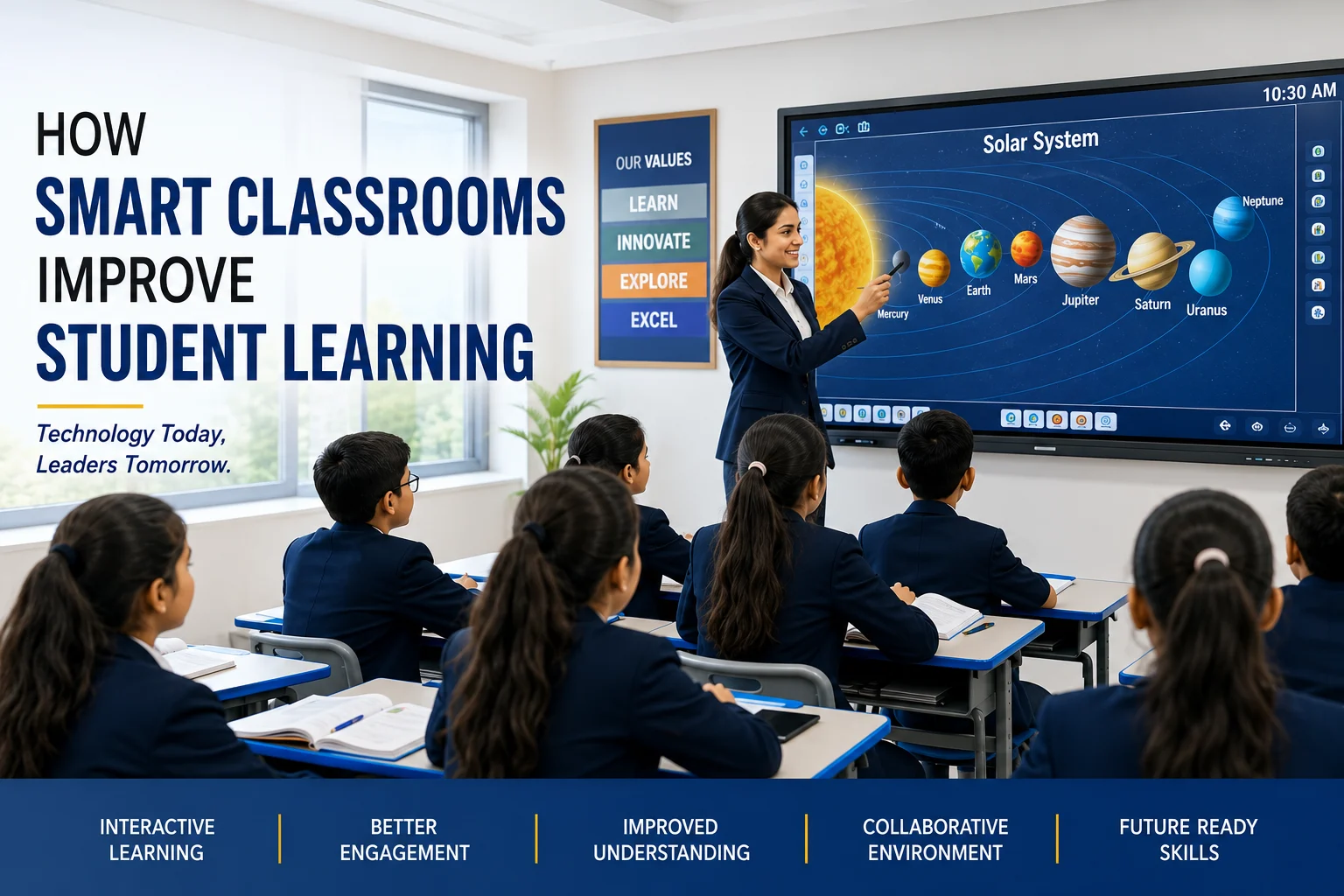
Education has evolved significantly over the past decade, and technology has become an essential part of the learning process. Traditional teaching methods are gradually being complemented by digital tools that make classrooms more engaging, interactive, and effective. One of the biggest innovations in education is the Smart Classroom, a modern learning environment that combines technology with quality teaching to improve student understanding and academic performance.
At Quantum Science School, Sardarshahar, smart classrooms are designed to create an engaging educational experience where students actively participate in lessons instead of simply listening to lectures. By integrating digital technology, multimedia content, and interactive teaching methods, students gain a deeper understanding of concepts while developing the skills needed for future academic and professional success.
In today’s competitive world, schools must prepare students not only for board examinations but also for higher education, competitive exams, and real-life problem-solving. Smart classrooms provide the ideal platform for achieving these goals.
What is a Smart Classroom?
A smart classroom is a technology-enabled learning space equipped with modern teaching tools such as interactive digital boards, projectors, educational software, internet-enabled resources, visual presentations, animations, and multimedia learning materials.
Unlike traditional classrooms where students primarily rely on textbooks and verbal explanations, smart classrooms provide a visual and interactive approach that makes learning more enjoyable and easier to understand.
Students can observe scientific experiments through animations, understand mathematical concepts with graphical demonstrations, and explore geographical locations through digital maps and videos. This interactive environment transforms education into a more practical and engaging experience.
Better Understanding Through Visual Learning
Research has consistently shown that students retain information more effectively when they can both see and hear the concepts being taught. Smart classrooms make learning visually engaging through videos, diagrams, charts, animations, and interactive presentations.
For example, instead of merely reading about the solar system, students can watch detailed 3D animations that explain planetary motion. Complex biological processes such as photosynthesis or the human circulatory system become much easier to understand through digital visualization.
At Quantum Science School, visual learning helps students grasp difficult concepts quickly while improving long-term memory and conceptual clarity.
Increased Student Engagement
One of the biggest challenges in traditional classrooms is maintaining student attention throughout the lesson. Smart classrooms address this issue by making every lesson interactive and engaging.
Teachers use quizzes, polls, digital presentations, educational videos, and interactive activities to encourage participation. Instead of passively listening, students become active contributors to the learning process.
This higher level of engagement leads to increased curiosity, improved classroom participation, and greater enthusiasm for learning.
Encouraging Concept-Based Learning
Modern education emphasizes understanding concepts rather than memorizing information. Smart classrooms support this approach by helping students visualize and apply theoretical knowledge to practical situations.
Interactive demonstrations allow teachers to explain difficult topics step-by-step, ensuring that students understand the “why” behind every concept rather than simply memorizing answers.
At Quantum Science School, concept-based learning forms the foundation of academic excellence and prepares students for board examinations as well as competitive exams like IIT-JEE and NEET.
Making Science and Mathematics More Interesting
Subjects like Physics, Chemistry, Biology, and Mathematics often seem difficult because many concepts are abstract and challenging to imagine.
Smart classrooms solve this problem by using simulations, animations, and virtual experiments that simplify complex topics.
Students can observe chemical reactions safely through virtual labs, understand geometry using dynamic diagrams, and learn physics through animated models that demonstrate motion, force, and energy.
This practical approach reduces fear of difficult subjects and builds confidence among students.
Personalized Learning Experience
Every student learns at a different pace. Some understand concepts quickly, while others require additional explanation.
Smart classroom technology allows teachers to adapt lessons according to the learning needs of individual students. Digital resources can be revisited whenever required, allowing students to revise difficult topics multiple times.
This personalized learning approach ensures that every student receives the support needed to achieve academic success.
Better Preparation for Competitive Examinations
Competitive examinations require conceptual understanding, analytical thinking, and strong problem-solving abilities.
Smart classrooms help students prepare effectively by providing access to digital practice tests, interactive question-solving sessions, educational videos, and conceptual explanations.
Quantum Science School integrates modern teaching methods with structured academic programs to prepare students for board examinations and future competitive exams, giving them a strong academic foundation.
Improving Teacher Effectiveness
Smart classrooms benefit teachers as much as students. Digital teaching tools help educators explain concepts more clearly and efficiently.
Instead of spending valuable class time drawing diagrams or writing lengthy notes on the board, teachers can use interactive presentations, videos, and digital illustrations to deliver lessons effectively.
This allows more time for discussions, doubt-solving, and personalized guidance.
Building Digital Skills for the Future
Technology has become an essential part of higher education and almost every profession. Introducing students to digital learning from an early age helps them develop technological confidence and digital literacy.
Students become familiar with educational software, online learning platforms, research techniques, presentations, and collaborative digital tools.
These skills prepare them for college education and future careers in science, engineering, medicine, business, and technology.
Creating a Collaborative Learning Environment
Smart classrooms encourage teamwork and collaborative learning through group discussions, digital projects, classroom activities, and interactive assignments.
Students learn to communicate effectively, solve problems together, exchange ideas, and develop leadership skills.
Collaborative learning improves critical thinking while helping students build confidence and social skills.
Instant Assessment and Feedback
Modern classroom technology enables teachers to conduct quick quizzes, online assessments, and interactive tests during classroom sessions.
Immediate feedback helps students identify their strengths and areas for improvement without waiting for traditional examination results.
Teachers can also monitor student performance continuously and provide timely academic support whenever needed.
A More Enjoyable Learning Experience
Children naturally enjoy learning when education becomes interesting and interactive.
Smart classrooms transform ordinary lessons into engaging educational experiences through videos, educational games, animations, simulations, and multimedia presentations.
Students become excited about attending classes because every lesson offers something new and interactive.
This positive learning environment improves attendance, classroom participation, and overall academic performance.
Why Parents Prefer Schools with Smart Classrooms
Parents today understand that education extends beyond textbooks. They seek schools that combine academic excellence with modern teaching methods to prepare their children for future challenges.
Schools equipped with smart classrooms offer:
- Interactive and engaging learning experiences
- Better conceptual understanding
- Enhanced academic performance
- Improved digital literacy
- Strong preparation for higher education
- Increased confidence and communication skills
- Future-ready learning environment
These advantages make smart classroom education one of the most valuable investments in a child’s future.
Smart Learning at Quantum Science School, Sardarshahar
At Quantum Science School, Sardarshahar, education goes beyond conventional teaching methods. The school integrates smart classroom technology with experienced faculty, concept-based learning, modern science laboratories, structured academic planning, and student-centered teaching practices.
The objective is not only to help students score excellent marks but also to develop logical thinking, creativity, confidence, communication skills, and problem-solving abilities.
With its commitment to academic excellence and innovation, Quantum Science School provides students with an educational environment that prepares them for board examinations, competitive entrance exams, and lifelong success.
Conclusion
Smart classrooms have transformed education by making learning more engaging, interactive, and effective. They help students understand concepts more clearly, improve academic performance, encourage creativity, and prepare learners for the technology-driven world of tomorrow.
By combining innovative teaching methods with quality education, schools can nurture confident, knowledgeable, and future-ready students. At Quantum Science School, Sardarshahar, smart classroom technology is an integral part of delivering holistic education that empowers every student to achieve academic excellence and personal growth.
Frequently Asked Questions (FAQs)
1. What is a smart classroom?
A smart classroom is a technology-enabled learning environment that uses digital boards, multimedia content, educational software, and interactive teaching tools to enhance student learning.
2. How do smart classrooms improve learning?
They improve engagement, simplify complex concepts through visual learning, encourage active participation, and help students retain information more effectively.
3. Are smart classrooms beneficial for board exam preparation?
Yes. Smart classrooms strengthen conceptual understanding, making students better prepared for board examinations and competitive entrance tests.
4. Why are smart classrooms important for modern education?
They develop digital literacy, critical thinking, collaboration, and problem-solving skills while making education more engaging and future-ready.
5. Does Quantum Science School use smart classroom technology?
Yes. Quantum Science School, Sardarshahar integrates smart classroom technology with concept-based teaching, experienced faculty, and modern educational practices to provide students with a comprehensive learning experience.